Alaska: the land of individuals and other endangered species. - T-shirt
A guy at the bar's words on the subject of the be-yourself diversity of live-free-or-die characters in Alaska: "This is such a great place. You don't have to worry about offending people; in fact, if you're not offending people, you're probably offending people."
The above conversation was had at Hooligan's Saloon, a respectable local establishment where I went for seafood chowder, drinks, and live music after work on Friday night. Other topics of conversation included fishing, bear hunting (iphone pic included!), fur-trapping, and the concealed weapons the man was carrying.
Interesting story: the musician was Hobo Jim, a famous singer-songwriter here and Outside. Back in 2010, on my first Alaskan venture, Reid and I hitch-hiked from Anchorage to Seward and just outside Seward we were picked up by a very nice lady who was in town for her husband's gig, and she gave us a free CD. None other than Hobo Jim's wife! Four years later, I'm listening to the man himself.
Saturday, June 14, 2014

Thursday, June 12, 2014
Run on the Beach
Just down the road: a beach with sand, seagulls, eagles, and tides! It looks out on the Cook Inlet, a huge body of water that reaches all the way up to Anchorage and varies greatly between high and low tide. The two large mountains across the Inlet are active volcanoes:


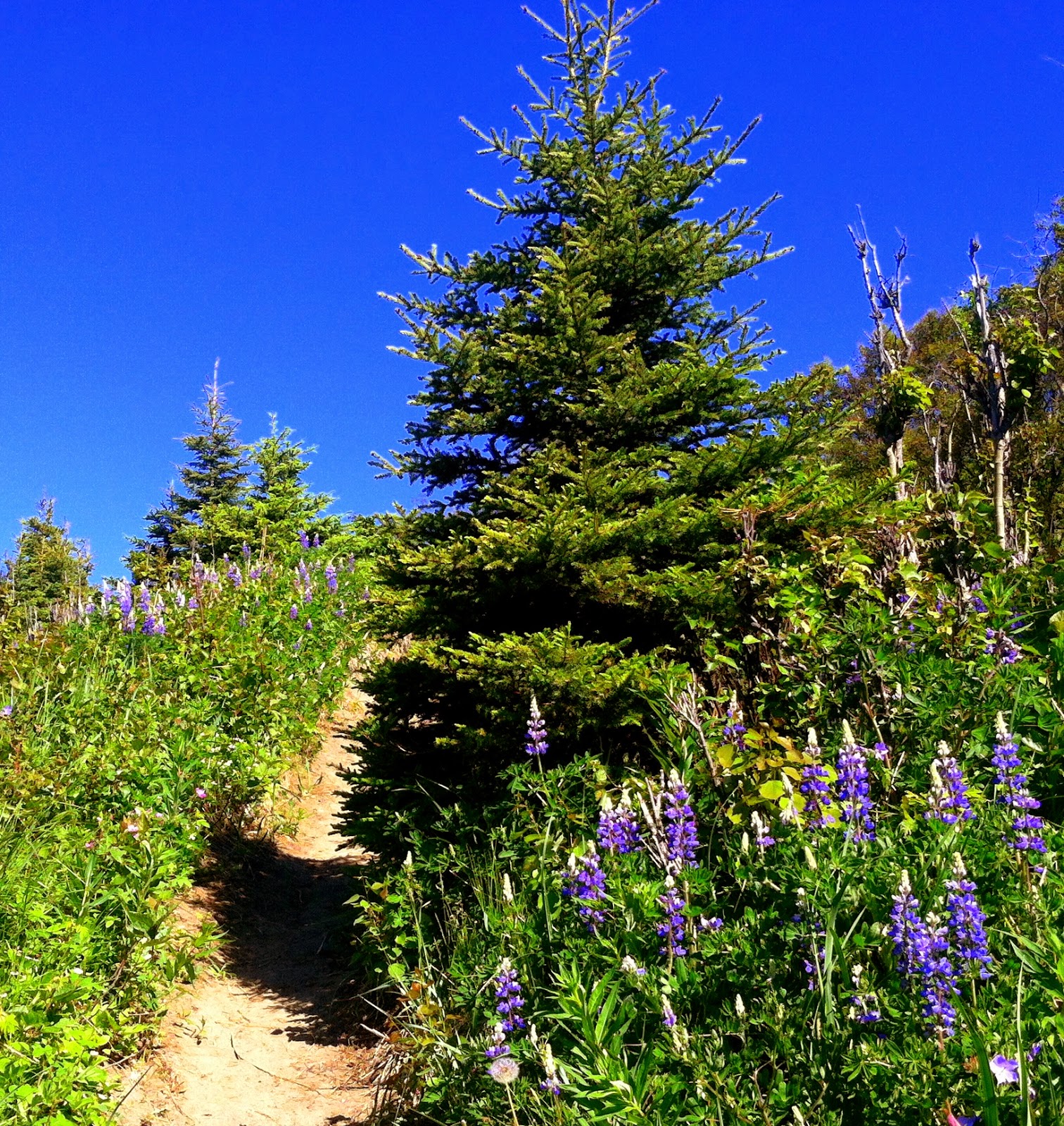 |
| Lupines growing beside a steep beach path |

One of my favorite scenes: Mt Redoubt (volcano) as seen across the marshes.
Monday, June 9, 2014
Hiking!
 |
| May your trails be crooked, winding, lonesome, dangerous, leading to the most amazing view. May your mountains rise into and above the clouds. -Edward Abbey |


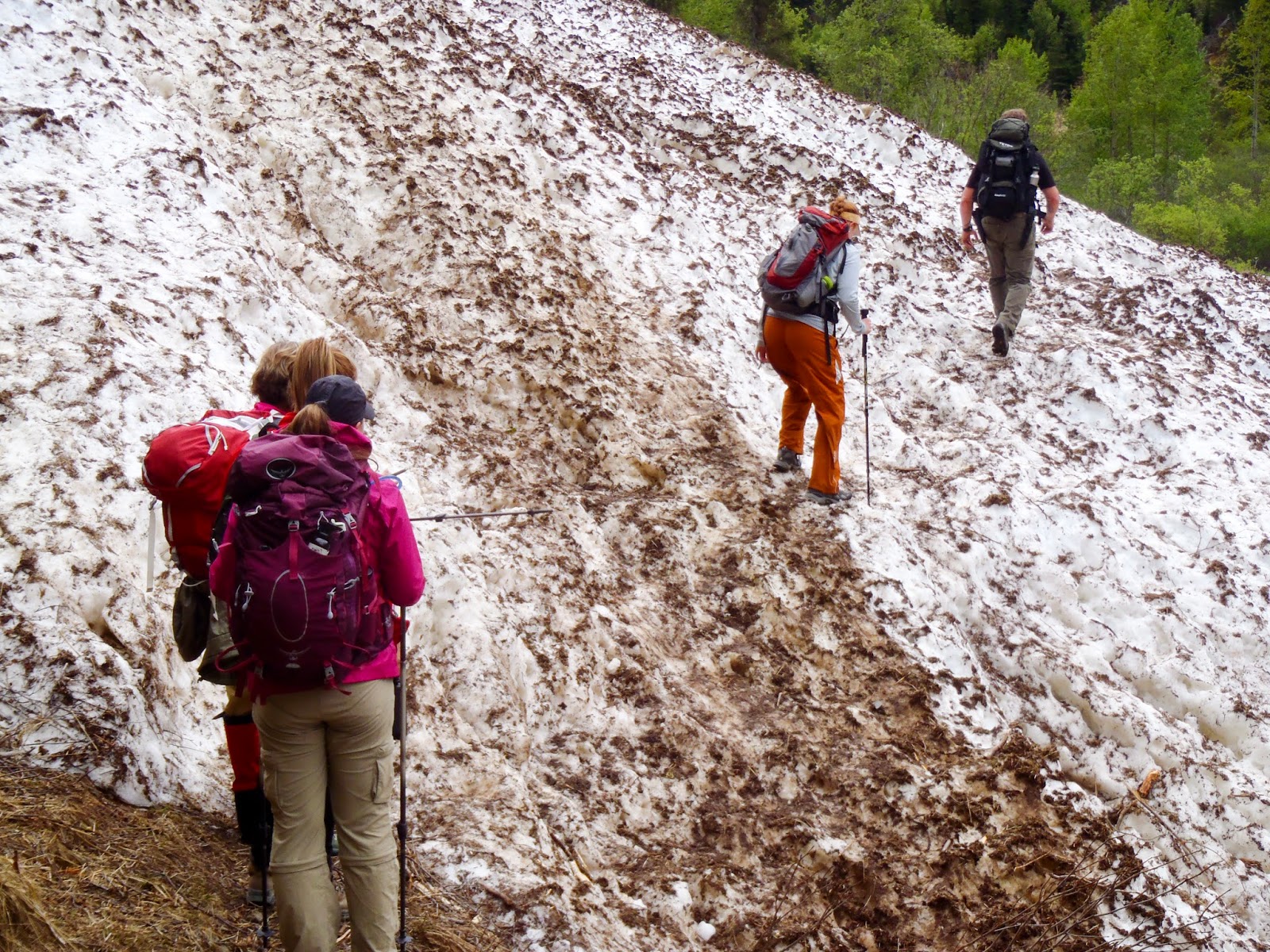
An avalanche covered the trail on a group hike-- getting across.

Saturday, June 7, 2014
Settling in

After Denali, I headed south to my new home on the Kenai Peninsula, which has been called "Alaska in a nutshell." All of the quintessential images that come to mind at the word "Alaska"--bears catching salmon in a river, glaciers crashing into the sea, snow-streaked mountains standing over lakes, cruise ships beside whales, bald eagles in the midnight sun, moose on the roads--most of those images probably originate (or at least can be found) on the Kenai Peninsula. For reference:

There I am in Soldotna. As you can see, it has the beautifully turquoise Kenai River running through it and every summer it fills up with salmon! The world record salmon was caught right here in Soldotna: 97 pounds. And just down the road in the Cook Inlet, the world's largest halibut weighed in at 466 pounds.
To give you a flavor of the town, here are some businesses and signs that I drive by everyday: Sportsmans Warehouse, Alaska Tackle, Antler and Horn Carvings, Fish Processing, Taxidermy, Harley Davidson, Talon Air Charters, Hooligan's Saloon, Maverick Saloon, Caribou Restaurant, RV Park, Brewery, Lots for Sale, Lakeside Cabins and Lodge, Fly-out Salmon Guides, "We Ship Fish!," and, of course, Good Time Charlie's "Showgirls."
To soften the edges of this rough caricature, there are also multiple churches and a decent amount of preaching on the radio. Plus a smattering of automotive stores, truck stops, pawn shops, fast food joints, hole-in-the-walls, and a trailer park. And at least one really good bakery.
More statistics, derived from my observations:
8/10 vehicles on the road are trucks or all-terrain vehicles-- a percentage even higher than Texas.
3/9 people on my recent group hike carried guns (for protection).
2/6 of my experienced rowers own planes and occasionally hunt bears.
I'll keep you appraised of further trends. But for now, here is the beautiful home in which I am staying:

It's lovely, with a master suite in the loft (open for visitors!), big windows looking out onto trees, and a sunny wrap-around deck with a grill (one of my favorite features). You can see my little old Subaru Legacy in front... she's running like a champ so far and I even bought an Anne Murray cassette to listen to in her. Very blessed in my temporary home.


Wednesday, June 4, 2014
The Exodus
Our third night in the backcountry (after the bear-sighting that day) was ferociously windy. Sustained winds shook our tents and gusts folded my tent on top of me within inches of my face. No amount of rocks or stakes could keep the windward side in place, so when it started raining early in the morning, water got in. I tried my stove but it would not stay lit in the wind-- no hot breakfast for us. After we packed hurriedly in the gusty cold rain, it was an easy decision to head straight for civilization. We had intended to stay in the backcountry for two more nights, but with everything soaked and cold, it would have been miserable as well as dangerous.
We hiked 10 miles in five hours without stopping to take off our packs. If I stopped for more than 30 seconds, I felt cold to my bones so we trudged, going straight through the river several times, over frozen snow fields, through silt, trying to walk as the crow flies, the most direct route. At points, the rain turned to sleet and blew horizontally into our faces.
One thing that is rarely well-portrayed in pictures of Denali wilderness is the scale: the distances are much greater than they appear. When Angela and I finally spotted our destination--the ranger station/bus stop-- we were still 2 and 1/2 hours away. But we eventually arrived, staggering up the riverbank to some mingling tourists that probably wondered why we looked like the living dead.
The bus ride back to the frontcountry took 3 1/2 hours, during which I ate an entire bag of trail mix and we spotted more wildlife. We resorted to a regular campsite, complete with a flat, protected tent area and a fire pit! The fire, combined with some late afternoon sunshine, dried out most of our gear and we went to sleep quite comfortably.
 Getting out of the backcountry ended up allowing us to see a greater variety of landscape, since the following three days were filled with various hikes (on trails!). The hike from the picture above climbed along a ridge and dropped down to three beautiful isolated lakes, where we had lunch. The trail ended on a highway and we hitch-hiked back, which was almost too easy: our thumbs were up for approximately 5 seconds...


We hiked 10 miles in five hours without stopping to take off our packs. If I stopped for more than 30 seconds, I felt cold to my bones so we trudged, going straight through the river several times, over frozen snow fields, through silt, trying to walk as the crow flies, the most direct route. At points, the rain turned to sleet and blew horizontally into our faces.
One thing that is rarely well-portrayed in pictures of Denali wilderness is the scale: the distances are much greater than they appear. When Angela and I finally spotted our destination--the ranger station/bus stop-- we were still 2 and 1/2 hours away. But we eventually arrived, staggering up the riverbank to some mingling tourists that probably wondered why we looked like the living dead.
The bus ride back to the frontcountry took 3 1/2 hours, during which I ate an entire bag of trail mix and we spotted more wildlife. We resorted to a regular campsite, complete with a flat, protected tent area and a fire pit! The fire, combined with some late afternoon sunshine, dried out most of our gear and we went to sleep quite comfortably.
A hike above Savage River.
A hike in the alpine zone, above the tree line. Very windy. We saw arctic ground squirrels, cousin to the prairie dog. To give you perspective, look for the tiny black dot on the trail in the middle left of the picture-- that's Angela!
The park road.
Occasionally we did easy hikes through lovely aspen forests.
On our last half-day in the Park, we rode a bus along the road in hopes of catching a glimpse of Mt McKinley (or Denali), the mountain after which the Park is named, the highest peak in North America. The mountain is only visible 30% of the time and is often obscured by haze or clouds. Luck was with us: the white blob in the middle right of the picture is Mt McKinley 80 miles away. Not the best picture, but there she is. You might not know it was it were it not completely snow-covered, unlike some of the smaller mountains around it. So we got to leave Denali having caught a glimpse of the mountain and having seen much much more in the way of landscape, flora, and fauna.
Sunday, June 1, 2014
Wildlife is real.


After leaving our first campsite (above), we had two beautiful days of hiking and camping. We forded the river several more times, but started taking our boots off and crossing barefoot (you're not supposed to do this, but dry boots were worth the risk of foot injury). We saw bear, wolf, and fox tracks. We cooked and ate 100 yards away from our tent and stored our food in bear-proof containers another 100 yards away..(required and distributed by the backcountry office). Everything smelly goes in there-- food, trash, toiletries. I couldn't peacefully sleep at night if even a tube of chapstick was left in my bag/tent.
On the third day, Angela and I didn't move camp but opted for a day hike up this mountain:


As I rested, in my peripheral vision, I saw movement on the snow-filled couloir (you can see it in the picture above). Crossing the snow, headed my way, was a mother Grizzly with two cubs. I wasn't alone after all! The instinctual "holy shit" adrenaline response ensued. Very briefly, I watched the two cubs scramble across the snow (very cute), but sadly didn't feel safe enough to observe any longer; the mom had not seen me (about 200 yards away) so I gave up my goal of the summit and ran/stumbled down the tundra, crashed through the thicket, breaking branches, tearing my pants, getting sticks stuck everywhere. I started singing to alert any lower-elevation bears that I was charging outta there and the hurry didn't subside until I was back in the safe, wide-open riverbed.
Even as I was retreating, I was psyched, as well as thankful for divine intervention: had I not seen them at that moment and kept ascending, our paths would've intersected at much closer range and who knows what would've happened! A couple days later, we saw another family of bears on the road, from the bus. This was also cool, but viewing them from the bus didn't deliver the thrill of seeing them come toward me on a lonely rocky peak, where their impressiveness was really felt.

Mother Grizzly with two year-old cubs, as seen from the bus!
"Those
who have packed far up into grizzly country know that the presence of
even one grizzly on the land elevates the mountains, deepens the
canyons, chills the winds, brightens the stars, darkens the forest, and
quickens the pulse of all who enter it."
- John Murray
- John Murray
Thursday, May 29, 2014
Entering the Backcountry
Denali is vast. The National Park is the size of Massachusetts and almost all of it is wilderness, accessible only by foot (if you were to walk continuously across every square mile, it would take over 11 years to see the entire thing). There is one ribbon of road running into it-- an old mining road that is now used by the Park Service buses to give visitors a glimpse of the terrain. Tundra, taiga, rivers, and mountains stretch in every direction.
There are a few trails around the entrance area, near the established tent and RV campsites and the visitor center. This is called the "frontcountry." The rest of the park-- 6 million acres-- is backcountry: undisturbed wilderness with no trails or human traces. The Park encourages you to hike all over it.
My friend Angela and I arrived in Denali prepared to enter the backcountry. After watching a safety video and receiving our free permit from the very friendly rangers, we boarded a bus to take us into the park. From the bus we saw our first wildlife: a moose and yearling, a handful of caribou, a marmot, and a ptarmigan. As the bus hugged a edge of a mountain pass, it started to snow.
We got off the bus at Toklat River. The lodge and RV-dwelling tourists on the bus bid us farewell and we started hiking north. After a five hour drive from Anchorage and three hours on the Park bus, finally strapping on our backpacks and setting foot on the ground was exhilarating. We followed the rocky river bed-- the Toklat is a braided stream so it has many shallow strands winding in and out of each other.

For a couple of hours we crossed little streams by picking our way on stones, but soon the strands converged into deeper channels and, to avoid wading through, we took to the embankment trees, taking up the "Hey Bear!" call so as not to surprise any predators... The woods proved almost impassable due to dense brush. Every twig scraping and snagging our packs sounded like a bear. We got out as soon as we could, back down to the riverbed, and were forced to do what we had vowed to avoid: get our feet wet. We waded through the rushing river, glacial water soaking our boots. Unpleasant but inevitable.
 We hiked on a little further with squishing feet, until around 9:30pm, when we hurriedly set up our tents as it started to hail. Our toes were numb; we wolfed down our food and got into our sleeping bags.
Sleeping with freezing toes was hard. I woke up early and found little relief as I shoved my feet into my frozen boots (literally. It was probably 25 or 30 degrees). A campfire would have solved so many problems, but they are prohibited in the backcountry. I paced back and forth to get warm, but wasn't too miserable due to the stunning scenery I soaked in as the day grew brighter:


There are a few trails around the entrance area, near the established tent and RV campsites and the visitor center. This is called the "frontcountry." The rest of the park-- 6 million acres-- is backcountry: undisturbed wilderness with no trails or human traces. The Park encourages you to hike all over it.
My friend Angela and I arrived in Denali prepared to enter the backcountry. After watching a safety video and receiving our free permit from the very friendly rangers, we boarded a bus to take us into the park. From the bus we saw our first wildlife: a moose and yearling, a handful of caribou, a marmot, and a ptarmigan. As the bus hugged a edge of a mountain pass, it started to snow.
We got off the bus at Toklat River. The lodge and RV-dwelling tourists on the bus bid us farewell and we started hiking north. After a five hour drive from Anchorage and three hours on the Park bus, finally strapping on our backpacks and setting foot on the ground was exhilarating. We followed the rocky river bed-- the Toklat is a braided stream so it has many shallow strands winding in and out of each other.
For a couple of hours we crossed little streams by picking our way on stones, but soon the strands converged into deeper channels and, to avoid wading through, we took to the embankment trees, taking up the "Hey Bear!" call so as not to surprise any predators... The woods proved almost impassable due to dense brush. Every twig scraping and snagging our packs sounded like a bear. We got out as soon as we could, back down to the riverbed, and were forced to do what we had vowed to avoid: get our feet wet. We waded through the rushing river, glacial water soaking our boots. Unpleasant but inevitable.
Sleeping with freezing toes was hard. I woke up early and found little relief as I shoved my feet into my frozen boots (literally. It was probably 25 or 30 degrees). A campfire would have solved so many problems, but they are prohibited in the backcountry. I paced back and forth to get warm, but wasn't too miserable due to the stunning scenery I soaked in as the day grew brighter:
Ice between the rocks.
Subscribe to:
Posts (Atom)